
A Buyer’s Guide to Car Sponge Manufacturers

Choosing the right Car Sponge Manufacturer is an important decision for retailers, distributors, wholesalers, car-care brands, and businesses looking to develop their own automotive cleaning products. A car sponge may appear to be a simple accessory, but its material, density, shape, absorbency, durability, packaging, and surface safety can significantly affect the user experience. If you are purchasing in bulk, selecting the right manufacturer can also influence product consistency, pricing, delivery times, and long-term business performance.
Whether you need basic washing sponges, detailing applicators, microfiber cleaning pads, or customized car-care accessories, it is worth understanding what to look for before placing an order. This guide explains the key factors buyers should consider, from materials and manufacturing quality to MOQ, customization, pricing, packaging, and supplier communication.
Why Choosing the Right Manufacturer Matters
A manufacturer does more than simply produce your products. The right manufacturing partner can help you maintain consistent quality, competitive costs, dependable production, and reliable supply.
This becomes particularly important when you sell products under your own brand. Customers expect every sponge they purchase to provide a similar level of performance. If one batch is soft and durable while another is rough or poorly finished, it can negatively affect customer satisfaction.
A dependable manufacturer should be able to maintain consistent specifications across production batches while also meeting agreed delivery schedules.
What Is a Car Sponge?
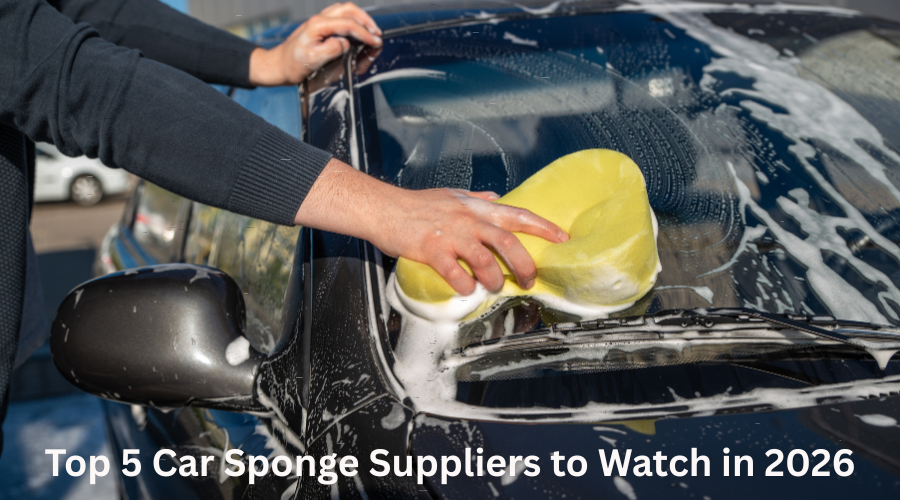
A car sponge is a cleaning accessory designed to help remove dirt, dust, mud, and other contaminants from automotive surfaces. Depending on its construction, it may be used for washing, applying cleaning products, polishing, or detailing.
Different sponge designs are intended for different purposes.
Common varieties include:
Car wash sponges
Detailing sponges
Applicator pads
Wheel-cleaning sponges
Tire-cleaning sponges
Interior cleaning sponges
Wax application pads
Heavy-duty cleaning sponges
The appropriate design depends on the intended application and the type of surface being cleaned.
Common Materials Used in Car Sponges
Material selection is one of the first things wholesale buyers should investigate.
Polyurethane Foam
Polyurethane foam is commonly used because it can provide a combination of softness, flexibility, absorbency, and durability.
Different foam densities can produce different characteristics. A softer foam may be appropriate for delicate surfaces, while a denser option may provide greater durability.
Microfiber
Microfiber is another popular choice for automotive detailing products. Its fine fibers can help capture dirt and moisture while providing a soft surface for cleaning.
Microfiber products are particularly useful when the goal is to reduce the risk of scratching delicate automotive finishes.
Cellulose-Based Materials
Some cleaning sponges use cellulose or similar absorbent materials. These can be useful for applications where water absorption is an important requirement.
Mixed Materials
Manufacturers may combine different materials to create products with specific performance characteristics. For example, one side may be designed for gentle cleaning while another offers more scrubbing ability.
Consider Sponge Density
Density can have a major effect on how a sponge feels and performs.
A low-density sponge may be lightweight and highly flexible, while a higher-density sponge can provide a firmer feel and potentially greater resistance to repeated use.
However, higher density does not automatically mean better quality.
The ideal density depends on the product's intended purpose.
For a premium vehicle-washing product, you may prioritize softness and surface safety. For wheel or tire cleaning, a more durable structure may be desirable.
Ask manufacturers about available densities and request samples before making a bulk purchase.
Shape and Ergonomics
A car sponge needs to be comfortable and practical to use.
Common shapes include:
Rectangular
Round
Oval
Curved
Contoured
Finger-pocket designs
The shape can influence grip, coverage, flexibility, and ease of use.
A large sponge may cover more surface area, while a smaller contoured design may make it easier to clean narrow or difficult-to-reach areas.
When developing a product for retail sale, consider how the sponge will feel in the customer's hand, not just how it looks in photographs.
Absorbency Is an Important Feature
For car washing, absorbency can affect how much water and cleaning solution a sponge can hold.
A sponge with suitable absorption can help distribute water or cleaning solution across the vehicle surface without requiring constant reapplication.
However, excessive absorption is not necessarily desirable for every application. A product designed for wax or polish application may require different characteristics from a traditional washing sponge.
This is another reason to select the material according to the intended use.
Surface Safety Should Be a Priority
Automotive paint can be sensitive to abrasive materials and trapped particles.
For products intended for exterior vehicle washing or detailing, manufacturers should pay attention to surface softness and material consistency.
A quality sponge should be designed to minimize the possibility of creating unwanted marks when used correctly.
Buyers should test products on appropriate surfaces before approving a large production run. If the sponge is intended for delicate paintwork, glass, chrome, or other sensitive surfaces, communicate these requirements clearly to the manufacturer.
Evaluate Manufacturing Quality
Two products may look similar but perform very differently.
When evaluating samples, examine:
Material consistency
Density
Shape accuracy
Edge finishing
Absorbency
Compression recovery
Surface texture
Odor
Durability
Color consistency
You should also check whether the sponge maintains its shape after repeated use.
A product that compresses permanently after only a few uses may not meet the expectations of customers looking for a reusable cleaning accessory.
Request Samples Before Bulk Production
One of the simplest ways to reduce purchasing risk is to request samples.
A sample gives you the opportunity to evaluate the actual product rather than relying entirely on product photographs or written specifications.
Test the sample for:
Softness: Is it suitable for the intended surface?
Absorbency: Does it hold and distribute water effectively?
Durability: Does it withstand repeated squeezing and washing?
Shape: Is the design comfortable and practical?
Cleaning performance: Does it remove dirt effectively?
If possible, compare samples from several manufacturers. This can help you identify differences in materials and manufacturing quality.
Understanding MOQ
MOQ means Minimum Order Quantity. It refers to the smallest quantity a manufacturer is generally willing to produce or supply under specified conditions.
MOQ can vary based on:
Product type
Sponge size
Material
Color
Packaging
Customization
Printing
Production requirements
Standard products may have lower MOQs than fully customized items.
For new businesses, a high MOQ can create unnecessary inventory risk. Ask whether the manufacturer offers samples, trial orders, mixed designs, or standard packaging for an initial purchase.
Customization and Private Label Options
If you are developing an automotive cleaning brand, customization can help differentiate your products.
Manufacturers may offer options such as:
Custom colors
Custom shapes
Printed logos
Embossed branding
Customized packaging
Product sets
Private-label labels
Custom product dimensions
Before requesting customization, prepare clear specifications.
Include the desired dimensions, material, density, color, logo placement, packaging style, and quantity.
Keep in mind that customization may increase both MOQ and production costs.
Packaging Considerations
Packaging serves two purposes: protecting the product and presenting it to customers.
For retail products, packaging can significantly influence how professional the product appears.
Possible options include:
Polybags
Paper cards
Printed boxes
Hanging packaging
Recyclable packaging
Window boxes
Multi-piece sets
For wholesale buyers, packaging also needs to be suitable for transportation and storage.
Ask about carton dimensions, units per carton, protective materials, and labeling requirements before finalizing an order.
Compare Pricing Carefully
Price is important, but it should not be the only factor.
When comparing manufacturers, request quotations based on identical specifications.
Compare:
Unit price
MOQ
Sample cost
Customization charges
Packaging costs
Tooling costs
Production time
Shipping expenses
Payment terms
A manufacturer offering a slightly higher unit price may provide better materials, quality control, packaging, or customer service.
The goal should be to identify the best overall value rather than simply the lowest quotation.
Ask About Production Capacity
If your business grows, you will need a manufacturer that can increase production with you.
Ask potential manufacturers:
What is your monthly production capacity?
How quickly can you fulfill repeat orders?
What happens during peak seasons?
Do you maintain raw-material inventory?
How long does production normally take?
A manufacturer that can handle your initial order but struggles with larger repeat orders may not be the right long-term partner.
Quality Control and Inspection
Quality control should be considered before, during, and after manufacturing.
A basic quality-control process may involve checking:
Raw materials
Production samples
Dimensions
Density
Appearance
Packaging
Finished-product quantities
For larger orders, buyers may also consider an independent pre-shipment inspection.
This can help identify problems before the products leave the manufacturing facility.
Communication Matters
Good communication can prevent many manufacturing problems.
A reliable manufacturer should respond clearly to questions about:
Product specifications
Pricing
Samples
Production
Packaging
Shipping
Quality control
Customization
If a manufacturer struggles to provide clear information before you place an order, it may be worth reconsidering the relationship.
Clear communication is especially important when ordering customized products, because even a small misunderstanding can affect an entire production batch.
Shipping and Logistics
Before placing a wholesale order, understand how the products will be shipped.
Car sponges are relatively lightweight, but their packaging volume can affect transportation costs.
Ask about:
Carton dimensions
Carton weight
Number of units per carton
Shipping method
Estimated lead time
Port of departure
Delivery terms
For larger orders, sea freight may be economical, while air transportation can be useful when faster delivery is required.
Calculate your total landed cost, rather than looking only at the factory price.
Questions to Ask a Manufacturer
Before selecting a manufacturing partner, consider asking:
What materials do you use?
What sponge densities are available?
Can you provide samples?
What is the MOQ?
Do you offer custom shapes?
Can you add a logo?
What packaging options are available?
What is the production lead time?
What quality-control procedures do you follow?
Can you support repeat orders?
What are your payment terms?
What shipping options do you offer?
The answers can help you compare manufacturers more objectively.
Common Mistakes Buyers Should Avoid
Choosing the Cheapest Manufacturer
A low price may be attractive, but poor quality can lead to customer concerns and returns.
Skipping Sample Testing
Never approve a large order without evaluating the actual product whenever samples are available.
Ignoring Material Specifications
Terms such as "high quality" do not provide enough information. Ask about the actual material, density, dimensions, and construction.
Ordering Excessive Quantities
Large orders can reduce unit costs, but they also increase inventory and cash-flow risks.
Failing to Confirm Packaging
Packaging requirements should be finalized before production begins.
Not Planning for Repeat Orders
If the product becomes successful, you need a manufacturer capable of maintaining consistent quality and supplying additional inventory.
FAQs
What type of sponge is best for washing cars?
There is no universal answer. A suitable sponge should be soft enough for the intended surface, sufficiently absorbent, easy to handle, and durable enough for repeated use.
How can I determine whether a manufacturer produces quality sponges?
Request samples and evaluate their material, density, softness, absorbency, shape, durability, and finishing. For larger purchases, consider professional product inspection.
Can car sponges be customized?
Yes. Depending on the manufacturer, customization may include shape, dimensions, colors, materials, branding, and packaging.
What should I consider besides the unit price?
Look at MOQ, sample quality, customization costs, packaging, production time, shipping, quality control, payment terms, and after-sales support.
Is MOQ important for small businesses?
Yes. A high MOQ can require significant upfront investment. Smaller businesses should look for manufacturers that offer reasonable trial quantities or standard products.
How long does manufacturing take?
Production time varies according to the product, quantity, customization, and manufacturer's workload. Always request a production schedule before placing an order.
Conclusion
Finding the right manufacturer of car sponge requires more than comparing product prices. Material quality, density, surface safety, absorbency, design, customization, MOQ, packaging, production capacity, quality control, and communication all play important roles in choosing a suitable manufacturing partner. Request samples, establish clear specifications, compare manufacturers using the same requirements, and calculate your complete purchasing and shipping costs before committing to a large order. By taking a careful approach, wholesalers, retailers, distributors, and automotive brands can develop reliable car-cleaning products that provide consistent quality and meet the expectations of their customers.


Comments